




Test engineer monitoring car crash on computer
Crash tests take place in “crash halls.” While engineers oversee tests on computer screens, the actual crash data is stored in digital recorders in the car.

Real and simulated car crash, May 2014
Comparing results from crash simulations with real crash tests improves the accuracy of both. Software engineers fine-tune their models based on real-world results.

Car crash simulation using LS-DYNA software, 2016
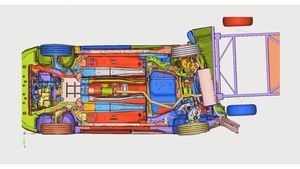
This virtual car simulation, shown in the program LS-DYNA, shows the FEM “mesh” covering the car. Each point in the mesh represents a series of calculations.

Deaths per billion miles traveled, 2014
Cars have become much safer over the years. From 1950 to 2014, the US population increased by over 150 million yet the rate of car crash deaths declined by more than half.

Cray T90 supercomputer system, February 1995
Simulations are more accurate because computers have become more powerful. Ford Motors used a Cray T90 supercomputer, like this one, to run car crash simulations in the mid-1990s.
Creating a Virtual Crash
Creating an actual car crash is easy (unfortunately). But how do you create a simulation?
Once designers have outlined a car’s basic form, they use the finite element method (FEM) to model its shape by plotting many interconnected points on the car’s surface.
Software then calculates how the forces in a crash would affect each of those points to determine the overall result of the impact.

Comparison of simulated and physical crash test results of VW Polo simulation, 1986
The first car crash simulation from a major car manufacturer was Volkswagen’s test of its Polo car in 1986. The simulation had only 5,600 elements. Today simulations have millions of elements.
When Software Saves Lives
What actually happens during a car crash? How does each part of the car react? What are the specific effects on passengers? To design safer cars you need to fully understand accidents. Software simulations help uncover the deadliest dangers—and test solutions.
More than 30,000 people die every year on American roads. Too many—but far fewer than a generation ago, thanks largely to seat belts and knowledge gained from simulations.