


1964: The First Widely-Used Analog Integrated Circuit is Introduced
David Talbert and Robert Widlar at Fairchild kick-start a major industry sector by creating commercially successful ICs for analog applications.
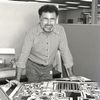
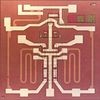
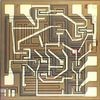
Analog, also called linear, circuits amplify and condition signals from continually varying phenomena such as sound, temperature, and radio waves. Because of the nearly infinite resolution required to process these signals, analog circuits demand high precision in design and manufacturing. Analog vacuum tube operational amplifier (op-amp) designs were paced by the concepts developed by Columbia University researcher Loebe Julie. The first germanium transistor op-amp appeared in 1958 with silicon versions in 1960. Nexus Research Labs offered the first pre-configured op-amp modules in 1962 followed shortly by Burr-Brown and Philbrick Researches.
Amelco, Fairchild, RCA, TI, and Westinghouse developed early analog ICs. H. C. Lin of Westinghouse employed on-chip component matching and his lateral PNP patent on a custom op amp for the Autonetics Minuteman II missile in 1963. But the Fairchild µA702 op amp, created in 1964 by the team of process engineer Dave Talbert and designer Robert Widlar, was the first widely-used commercial product. Their 1965 successor, the µA709, established a mass market for analog ICs. Talbert and Widlar moved to Molectro (later acquired by National) in late 1965 where they built a linear dynasty beginning with the LM101. Then in 1968 Dave Fullagar of Fairchild one-upped the LM101 by adding an internal compensating capacitor to deliver the µA741, the most popular op-amp of all time.
Specialty analog IC manufacturers evolved extensive catalogs of amplifiers, comparators, data converters, power management devices, and numerous specialty circuits for automotive, consumer and communications applications. Analog devices typically have much longer life cyles than digital I/Cs. Examples of 40 year-old designs that remain widely used today include Fullagar's µA741 op-amp and the 555 timer created by Hans Camenzind for Signetics.
Contemporary Documents
- Lin, Hung Chang, "Complementary transistor structure," U. S. Patent 3,197,710 (Filed May 31, 1963. Issued July 27, 1965).
- Lin, Hung Chang, "Method of making Complementary Transistor Structure," U. S. Patent 3,412,460 (Filed May 31, 1963. Issued November 26, 1968).
- Widlar, R.J. "A monolithic operational amplifier," Fairchild Semiconductor Application Bulletin APP-105/4 (April 1966).
- Giles, James, N. ed. Fairchild Semiconductor Linear Integrated Circuits Applications Handbook. (Mountain View, CA: Fairchild Semiconductor 1967) pp. 33-72.
- Gilbert, Barrie. "A Precise Four-Quadrant Multiplier with Subnanosecond Response," IEEE Journal of Solid-State Circuits Vol. 3, No. 4 (1968) pp. 365-373.
More Information
- Augarten, Stan. "A Semiconductor Best-Seller - µA709," State Of The Art: A Photographic History of the Integrated Circuit. (New Haven & New York: Ticknor and Fields, 1983) pp. 18.
- Camenzind, H. "Redesigning the old 555," IEEE Spectrum, vol. 34, No. 9, (September 1997) pp. 80-85.
- Lécuyer, Christophe. Making Silicon Valley: Innovation and the Growth of High Tech 1930-1970. (Cambridge, MA: The MIT Press, 2006) p. 248.
- Jung, Walter G. ed. Op Amp Applications Handbook. (Reed/Elsevier, 2006) pp. xv-xvi and Chapter 8.
- Lojek, Bo. History of Semiconductor Engineering (Springer, 2006). pp. 247-290.
- Lee, Thomas H. "Tales of the Continuum: A Subsampled History of Analog Circuits," IEEE Solid-State Circuits Society Newsletter (October 2007).
- Young, Ian. "A History of the Continuously Innovative Analog Integrated Circuit," IEEE Solid-State Circuits Society Newsletter (October 2007).
Oral History transcripts at the Computer History Museum
Other Oral Histories
- Sporck, Charles Fairchild and National. The Silicon Genesis Interviews (2.21.2000). Department of Special Collections, Stanford University Libraries, Stanford, California.
- Gifford, Jack Fairchild and Maxim. The Silicon Genesis Interviews (7.21.2002). Department of Special Collections, Stanford University Libraries, Stanford, California.
- Dobkin, Bob & Williams, Jim National and Linear Technology. The Silicon Genesis Interviews (4.19.2006). Department of Special Collections, Stanford University Libraries, Stanford, California.