


1965: Semiconductor Read-Only-Memory Chips Appear
Semiconductor read-only-memories (ROMs) offer high density and low cost per bit.
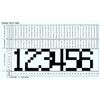
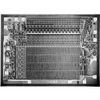
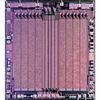
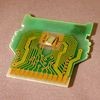
As data is permanently written into a Read Only Memory during the manufacturing process, ROM storage is used for information that will remain unchanged throughout the life of a system, such as microprogram code, look-up tables, character generation, etc. Integrated circuit ROMs are built from arrays of diodes placed between signal wires organized in rows and columns. The last masking step of the wafer fabrication process makes connection to the specific diodes required to implement the customer's code. As a diode represents the smallest possible memory cell structure, ROM devices offer the highest density and lowest cost per bit form of semiconductor memory.
In 1965 Sylvania produced a 256-bit bipolar TTL ROM for Honeywell that was programmed one bit at a time by a skilled technician at the factory who physically scratched metal link connections to selected diodes. Production orders were satisfied with custom-mask programmed devices. Also in 1965 General Microelectronics developed slower but four-times larger 1024-bit ROMs using MOS technology. By the early 1970s Fairchild, Intel, Motorola, Signetics, and TI offered 1024-bit TTL ROMs, while AMD, AMI, Electronic Arrays, General Instrument, National, Rockwell and others produced 4096-bit (4K) MOS devices.
Desktop calculator consumption, the first high-volume application, was surpassed by video game cartridges that used hundreds of millions of 16K and larger devices from U. S. and Japanese vendors. Production of Nintendo's first Super Mario Brothers NES game alone exceeded 40M units. As each ROM is manufactured to order, customers were often frustrated with long delivery times and vendors overwhelmed by production logistics. Relief came in the form of user-programmable ROMs (PROMs). (1971 Milestone)
Contemporary Documents
- Boysel, Lee. "Memory on a Chip: A Step toward Large Scale Integration." Electronics (Feb. 6, 1967) p. 92.
- Boysel, Lee. "Cutting System Cost with MOS," Electronics(January 20, 1969) pp. 105-107.
More Information
- Finn, Calvin L "All Semiconductor Memory System Includes Read-Only and Read/Write Chips," HP Journal (December, 1972) pp. 22-24.