


1969: Schottky-Barrier Diode Doubles the Speed of TTL Memory & Logic
Design innovation enhances speed and lowers power consumption of the industry standard 64-bit TTL RAM architecture. Is quickly applied to new bipolar logic and memory designs.
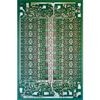
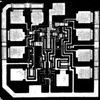
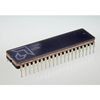
Since 1963 TTL (1963 Milestone) device complexity had advanced twenty-fold but switching speeds remained relatively unchanged at delays of 10-15 ns per gate. Speed is determined by how quickly charge stored in a transistor can be removed. Gold-doping (1961 Milestone) improved this but was difficult to control. In 1964 J. R. Biard of Texas Instruments (T.I.) proposed using a metal-semiconductor diode, called a Schottky-barrier diode (1931 Milestone), to shunt charge around the transistor. Ted Jenkins and Garth Wilson of Fairchild fabricated such a diode on a bipolar integrated circuit in 1967. Concurrently Japan's Electrotechnical Laboratory developed a similar design. Intel designers Richard Bohn and H. T Chua used a Schottky diode in the design of the company's first product, the i3101 64-bit RAM. Introduced in 1969, the device was nearly twice as fast as earlier implementations. (1966 Milestone)
In 1971 T.I. introduced the 74S Series TTL logic family using Schottky diodes to achieve 3 ns gate delays for high-speed applications. Low-power Schottky versions, designated LS, quickly replaced the original 7400 devices by offering the same speed at one fifth the power consumption. Chairman Mark Shepherd described 7400LS as "the single most profitable product line in the history of Texas Instruments." AMD, Fairchild, Motorola, National, and Signetics also entered the market. Later generations, including Fairchild Advanced Schottky Technology (FAST), combined Schottky diodes with oxide-isolation processes for sub-2ns delays.
In the mid-1970s micro-programmable "bit-slice" processor families from AMD, Intel, MMI, and Signetics used Schottky technology to integrate LSI building blocks for very high performance arithmetic processing applications. (1979 Milestone)
Contemporary Documents
- Biard, J. R. "Unitary Semiconductor High Speed Switching Device Utilizing a Barrier Diode" U. S. Patent 3,463,975 (Filed December 31, 1964. Issued August 26, 1969).
- Tarui, Y., Hayashi, Y., Teshima, H., Sekigawa, T. "Transistor Schottky-Barrier diode integrated-logic circuit," Solid-State Circuits Conference. Digest of Technical Papers. 1968 IEEE International,Vol. XI (Feb 1968) pp.164- 165.
- Chenette, E. R., Kleimack, J. J., Edwards, R., & Pedersen, R. A. "Integrated Schottky-Diode Clamp for Transistor Storage Time Control," Proceedings of the IEEE, Vol. 56, Issue 11 (Feb. 1968) pp. 232-233.
- Jenkins, Robert T. and Wilson, Garth H. "Schottky-Barrier Diode Process and Devices," U. S. Patent 3,623,925 (Filed January 10, 1969. Issued November 30, 1971).
- Noyce, R.N., Bohn, R.E. and Chua, H.T. "Schottky Diodes Make IC Scene," Electronics (July 21, 1969) pp. 74-80.
More Information
- Engineering Staff, The. The TTL Data Book for Design Engineers. (Dallas: Texas Instruments, 1973).
- Mick, John and Brick, Jim. Bit-Slice Microprocessor Design. (New York: McGraw-Hill Inc.1980)
- Smits, F. M. ed. A History of Engineering and Science in the Bell System: Electronics Technology (1925-1975) (AT&T Bell Laboratories, 1985) pp. 109-110.