

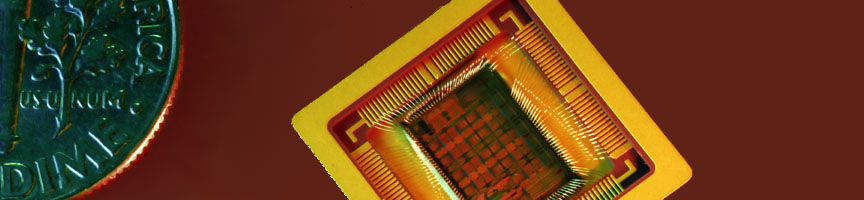
1958: All Semiconductor "Solid Circuit" is Demonstrated
Jack Kilby produces a microcircuit with both active and passive components fabricated from semiconductor material.
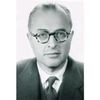
As computer systems grew more complex, engineers sought simpler ways to interconnect the thousands of transistors they employed. Government agencies funded micro-module and multi-chip hybrid circuit projects in search of a solution to this problem. In 1952, G. W. A. Dummer of England's Telecommunications Research Establishment proposed "With the advent of the transistor and the work in semiconductors generally, it seems now possible to envisage electronic equipment in a solid block with no connecting wires."
From the mid to late 1950s several projects succeeded in integrating multiple components on a chip. At RCA Harwick Johnson patented an oscillator and Torkel Wallmark and Sanford Marcus built shift registers and logic gates. Arthur D'Asaro and Ian Ross of Bell Labs fabricated a four-stage counter for telephone applications. Joe Logue and Rick Dill of IBM built a counter using a double-base diode structure. Yasuro Tarui of Japan's MITI and Richard Stewart of TI filed multiple device patents. Dudley Buck of MIT developed the cryotron, an integrated superconducting element. While achieving various degrees of functionality, none of these ideas yielded a solution to the challenge of general-purpose system integration.
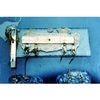
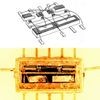
On September 12, 1958, Jack Kilby of Texas Instruments built a circuit using germanium mesa p-n-p transistor slices he had etched to form transistor, capacitor, and resistor elements. Using fine gold "flying-wires" he connected the separate elements into an oscillator circuit. One week later he demonstrated an amplifier. T.I. announced Kilby's "solid circuit" concept in March 1959 and introduced its first commercial device in March 1960, the Type 502 Binary Flip-Flop priced at $450 each. However the flying-wire interconnections were not a practical production technique and only a few dozen units were shipped to customers for evaluation purposes until the Series 51 DCTL "fully-integrated circuit" devices using deposited-metal planar technology were available (1959 Milestone) .
Contemporary Documents
- Dummer G. W. A. "Electronic Compnents in Great Britain," Proceedings Components Symposium, Washington, DC, (May 6, 1952) pp. 15-20.
- Johnson, H. "Semiconductor Phase Shift Oscillator and Device" U. S. Patent 2816228 (Filed May 21, 1953. Issued December 10, 1957).
- Buck, D. A. "The Cryotron-A Superconductive Computer Component," Proceedings of the IRE Vol. 44 No. 4 (April 1956) pp. 482-493.
- Kilby J. S., "Miniaturized Electronic Circuits" U. S. Patent 3138743 (Filed February 6, 1959. Issued June 23, 1964).
- Stewart, Richard F. "Integrated Semiconductor Circuit Device" U. S. Patent 3138747 (Filed February 12, 1959, Issued June 23, 1964).
- Wallmark, J. T. and Marcus, S. M. "Integrated Semiconductor Devices," RCA Engineer Vol. 5, No. 1 (June-July 1959) pp. 42-45.
- Wallmark, J. T. and Marcus, S. M. "Semiconductor devices for microminiaturization," Electronics Vol. 32 (June 26, 1959) pp. 35-37.
- D'Asaro, L. A. "A stepping transistor element," 1959 Wescon Convention Record, Pt. 3 pp. 37-42.
- Kilby, J. S. "Semiconductor solid circuits," Electronics Vol. 32 (August 7, 1959) pp. 110-111.
- Lathrop, J. W., Lee, R. E., and Phipps, C. H. "Semiconductor Networks for Micro-electronics." Electronics (May 13, 1960) p. 69.
- Tsvedos, T. J. "Introduction to Microsystems and the RCA Micromodule," The RCA Micromodule Program: Components and Application AIEE Electronics Division, Los Angles Symposium, Los Angles California (May 15-17, 1961) p. 3.
More Information
- Dummer, G. W. A. and Granville, J. W. Miniature and Microminiature Electronics (New York: John Wiley and Sons, 1961) pp. 263-300.
- Dummer, G. W. A. "A History of Microelectronics Development at the Royal Radar Establishment," Microelectronics and Reliability (Pergamon Press 1965) Vol. 4, pp. 193-219.
- Kilby, J. S. "Invention of the integrated circuit," IEEE Transactions in Electron Devices, Vol. ED-23, No. 7 (July 1976) pp. 648-654.
- Smits, F. M. ed. A History of Engineering and Science in the Bell System: Electronics Technology (1925-1975) (AT&T Bell Laboratories, 1985) pp. 101-129.
-
Logue, Joseph, C. "From Vacuum Tubes to Very Large Scale Integration: A Personal Memoir," IEEE Annals of the History of Computing Vol. 20 No. 3 (1998) p. 61.
- Kilby, Jack S. "Origins of the Integrated Circuit," Proceedings of the Eighth International Symposium on Silicon Materials Science and Technology, Vol. 98-1, (Electrochemical Society, April 1998) pp. 342-349.
- Kilby, Jack S. "The Integrated Circuit's Early History," Proceedings of the IEEE, Vol. 88, No. 1, (January, 2000) pp. 109 -111.
- Kilby J. S., "Turning Potential into Reality: The Invention of the Integrated Circuit" Nobel Lecture December 8, 2000 Nobel Lectures, Physics 1996-2000, Editor Gösta Ekspong (Singapore: World Scientific Publishing Co., 2002).
- Augarten, Stan. "The Microelectronic Revolution Begins," State Of The Art: A Photographic History of the Integrated Circuit. (New Haven & New York: Ticknor and Fields, 1983) p. 6.
- Reid, T. R. The Chip: How Two Americans Invented the Microchip and Launched a Revolution. (New York: Simon & Schuster, 1984). Revised and updated edition published by Random House, 2001.
- Riordan, M. & Hoddeson, L. Crystal Fire: The Birth of the Information Age. (New York: W. W. Norton, 1997) pp. 256-261.
- Bassett, Ross Knox. To the Digital Age. (Baltimore: The Johns Hopkins University Press, 2002) pp. 38-39.
- Saxena, Arjun N. "Monolithic Concept and the Inventions of Integrated Circuits by Kilby and Noyce" Technical Proceedings of the 2007 Nanotechnology Conference and Trade Show Vol. 3 (May 20-24, 2007) pp. 460-474.
- Saxena, Arjun N. Invention of Integrated Circuits. (Singapore: World Scientific Publishing Co. Pte. Ltd., 2009).
Oral History transcripts at the Computer History Museum
Oral Histories
- Kilby, Jack S. An oral history interview with Arthur L. Norberg, 6.21.1984, Dallas, Texas. Charles Babbage Institute, University of Minnesota, Minneapolis.
- Lathrop, Jay W. An oral history conducted in 1996 by David Morton, IEEE History Center, Rutgers University, New Brunswick, NJ, USA.
- Wallmark, J. T. An oral history conducted in 1996 by Frederik Nebeker, IEEE History Center, New Brunswick, NJ, USA