
Exhibits At the Museum

This Day in History

      December 2013
       
1234567
891011121314
15161718192021
22232425262728
293031    

December 23, 1909

First ACM President John H. Curtiss is Born

John Hamilton Curtiss is born on December 23, 1909. He obtained an MS degree in statistics from Northwestern University in 1930, and a PhD from Harvard in 1935. He obtained an MS degree in statistics from Northwestern University in 1930, and a PhD from Harvard in 1935. He had taught at Cornell University (1935-1943) and had served in U.S. Navy (1943-1946). In 1946 Curtiss joined National Bureau of Standards, where in 1947 he became a chief of the Applied Mathematical Division (AMD), the first centralized national computing center dedicated to accelerate the progress of USA in the computing industry. AMD's expertise proved the necessity of development of the UNIVAC, the SEAC, and the SWAC computers. At the same time Curtiss played the crucial role in the organization of ACM, then Eastern Association of Computing Machinery, and in 1947 he became the first ACM president.

Curtiss remained at NBS until 1953. From 1954 to 1959 he was an executive director of the American Mathematical Society. In 1959 he became a professor of mathematics at the University of Miami, where he remained until his death in 1977.

While no one can recall Curtiss at the console of a computer, he always said that "I was involved in the salt mines of computing."


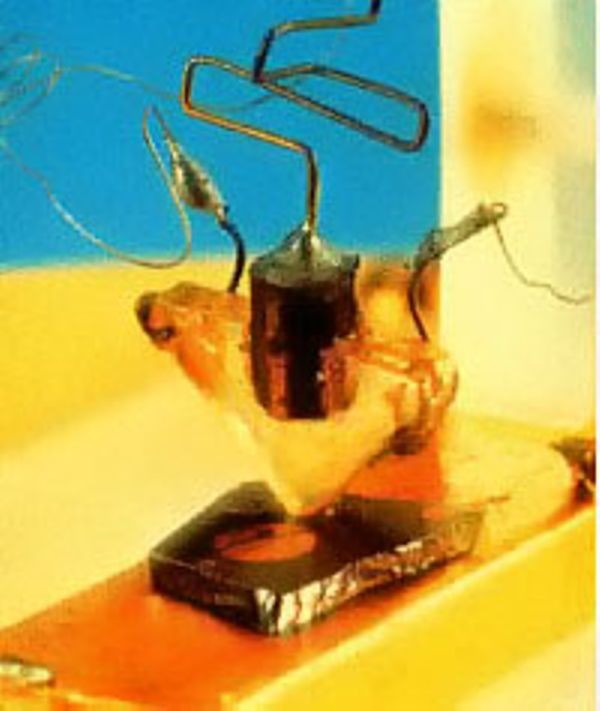
The point-contact transistor

December 23, 1947

Bardeen and Brattain demonstrate the transistor to the Bell Labs brass

It was the point-contact transistor, made from strips of gold foil on a plastic triangle, pushed down into contact with a slab of germanium. To measure the amplification they hooked up a microphone to one end of the device and a loudspeaker to the other. One by one, the men picked up the microphone and whispered hello; the loudspeaker at the other end of the circuit shouted HELLO!

Later, realizing that another major breakthrough in electronics had occurred in Bell’s lab, Shockley wrote Hearing speech amplified by the transistor was in tradition of Alexander Graham Bell’s famous ‘Mr. Watson, come here, I want you.’