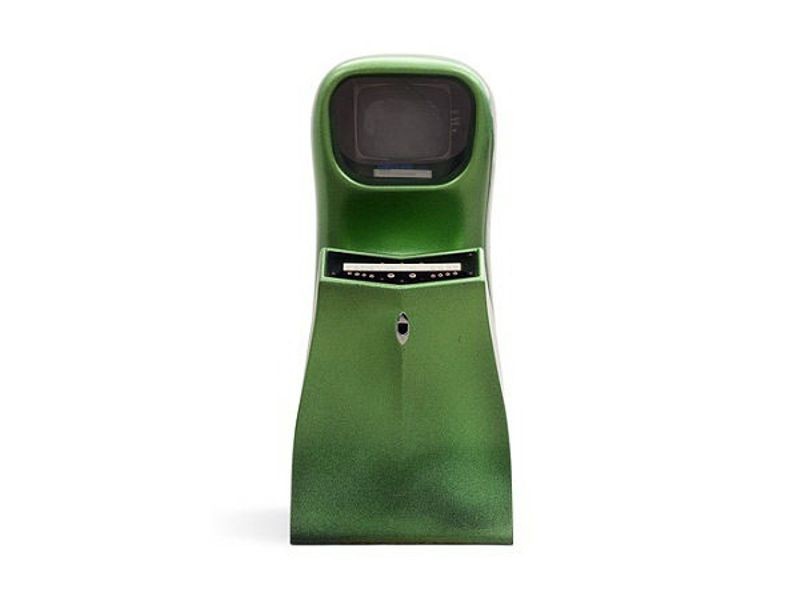
Computer Space arcade game
The cult success of Steve Russell's SpaceWar! and other early space battle games led Nolan Bushnell and Ted Dabney to design Computer Space, one of the earliest electronic arcade games. Using no microprocessor, RAM, or ROM, Computer Space was a simple technical design that still allowed for complex gameplay, so complex that many noted there was a steep learning curve involved in playing. While Computer Space did not sell well, it was featured in films like Jaws and Soylent Green.
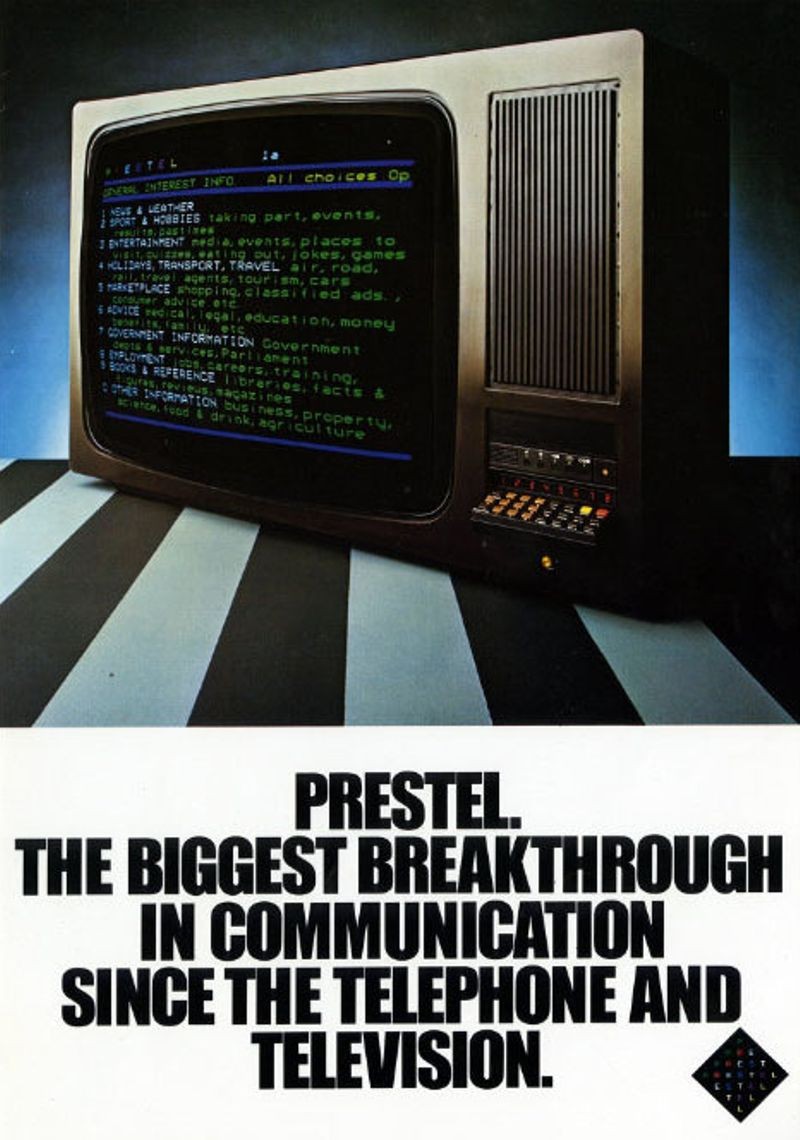
Brochure for the UK’s Prestel videotex system
By1971 Sam Fedida at the British Post Office and teams at the BBC and the IBA (Independent Broadcasting Association) have started developing Web-like information systems that use televisions for display. The two latter systems, based on work by Philips, broadcast data on an unused portion of the TV signal. They evolve into the Teletext information services found on most European TVs into the 2000s. Sam Fedida's videotex standard at the Post Office (which also runs the telephone system) uses phone lines, and has high ambitions for broad-reaching uses like today’s Web. It becomes the foundation of England’s Prestel and, later, France’s wildly successful Minitel.
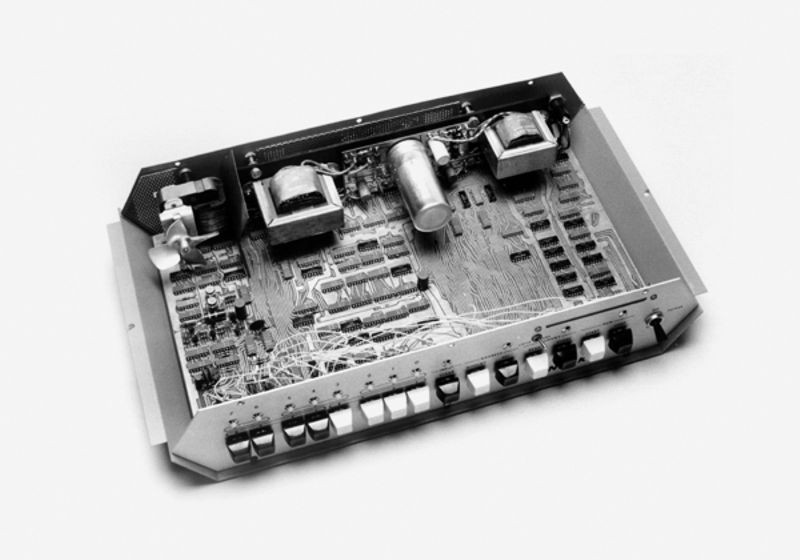
Kenbak-1
One of the earliest personal computers, the Kenbak-1 is advertised for $750 in Scientific American magazine. Designed by John V. Blankenbaker using standard medium-- and small-scale integrated circuits, the Kenbak-1 relied on switches for input and lights for output from its 256-byte memory. In 1973, after selling only 40 machines, Kenbak Corporation closed its doors.
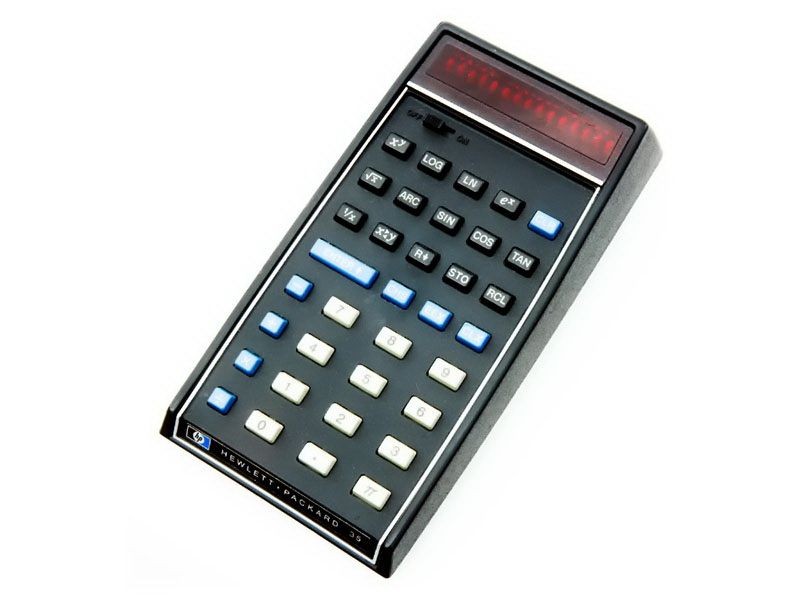
HP-35 handheld calculator
Initially designed for internal use by HP employees, co-founder Bill Hewlett issues a challenge to his engineers in 1971: fit all of the features of their desktop scientific calculator into a package small enough for his shirt pocket. They did. Marketed as “a fast, extremely accurate electronic slide rule” with a solid-state memory similar to that of a computer, the HP-35 distinguished itself from its competitors by its ability to perform a broad variety of logarithmic and trigonometric functions, to store more intermediate solutions for later use, and to accept and display entries in a form similar to standard scientific notation. The HP-35 helped HP become one of the most dominant companies in the handheld calculator market for more than two decades.
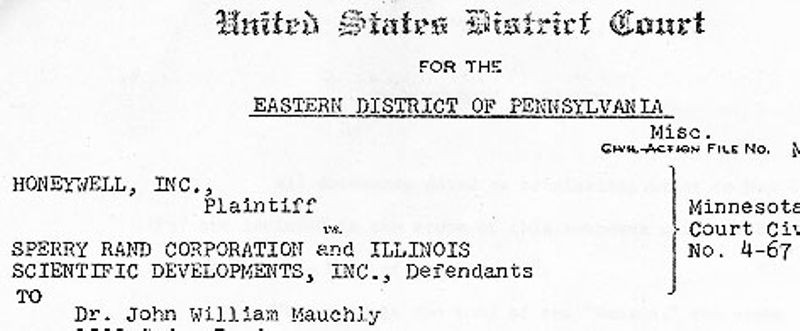
Honeywell, Inc. vs. Sperry Rand court document
In 1964, Sperry Rand Corporation received a patent, initially filed by J. Presper Eckert and John Mauchly, for the ENIAC computer developed during World War II. Sperry Rand sued Honeywell on claims of patent infringement, while Honeywell filed a suit charging Sperry Rand with monopolistic practices and fraud, seeking to invalidate the patent. Judge John Sirica ruled that Sperry Rand's patent was unenforceable, partly due to problems with the filing by Eckert and Mauchly, as well as previous publications such as John von Neumann's First Draft of a Report on the EDVAC. Perhaps the most significant finding was that “Eckert and Mauchly did not themselves invent the automatic electronic computer, but instead derived that subject matter from one Dr. John Vincent Atanasoff.” The ruling placed the idea for the electronic digital computer in the public domain so that any company could pursue computer design and manufacture without having to pay royalties for the basic idea of the computer.
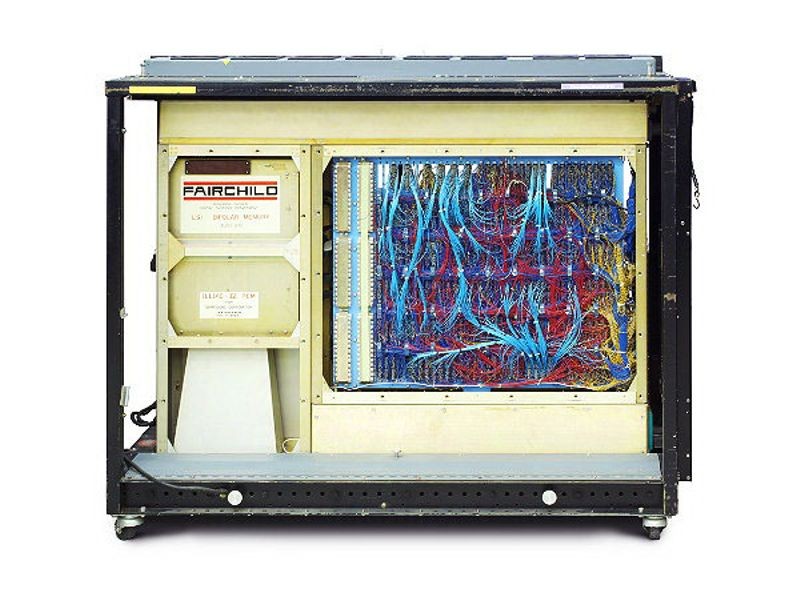
Fairchild bipolar memory unit for the ILLIAC IV
The ILLIAC IV supercomputer is delivered to NASA Ames Research Center at Moffett Field, California. One Fairchild-built Processing Element Memory (PEM), which stores 16,834 bytes, was in each of ILLIAC IV’s 64 processors. The 131,072-bit PEM was built by Fairchild using their new 256-bit bipolar SRAM chips. This was the first commercial use of commodity semiconductor memory in a large computer system.
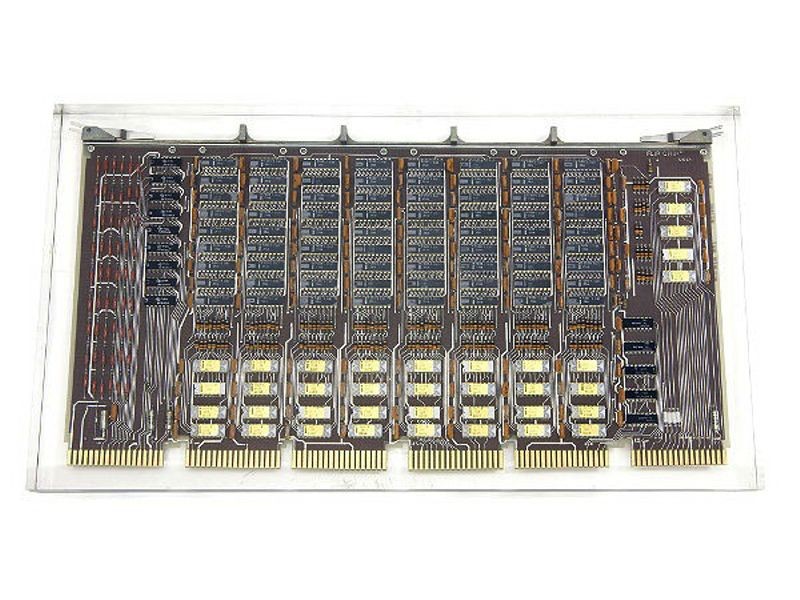
DEC PDP-11 minicomputer memory board with Intel 1103 memory chips
The introduction of the 1 KB Intel 1103 memory chip marks both the beginning of the end for the use of magnetic core in computers -- in use since the mid-1950s -- and the start of the semiconductor dynamic random-access memory (DRAM) integrated circuit memory. The 1103 sold slowly at first, but this likely helped the development team at Intel, which was still ironing out details about the chip's specifications after its initial release. However, at a price of 1¢ per bit and with a speed compatible with existing logic circuits, sales soon skyrocketed.
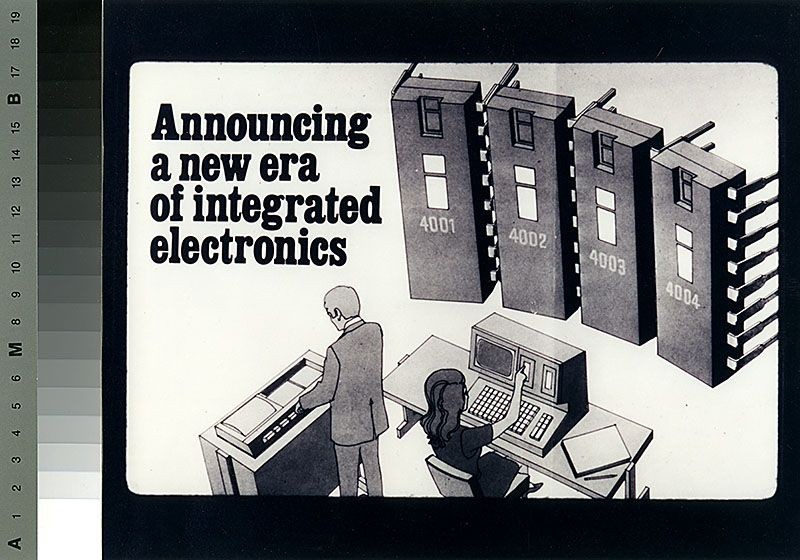
Advertisement for Intel's 4004
Computer History Museum
The first advertisement for a microprocessor, the Intel 4004, appears in Electronic News. Developed for Busicom, a Japanese calculator maker, the 4004 had 2250 transistors and could perform up to 90,000 operations per second in four-bit chunks. Federico Faggin led the design and Ted Hoff led the architecture.
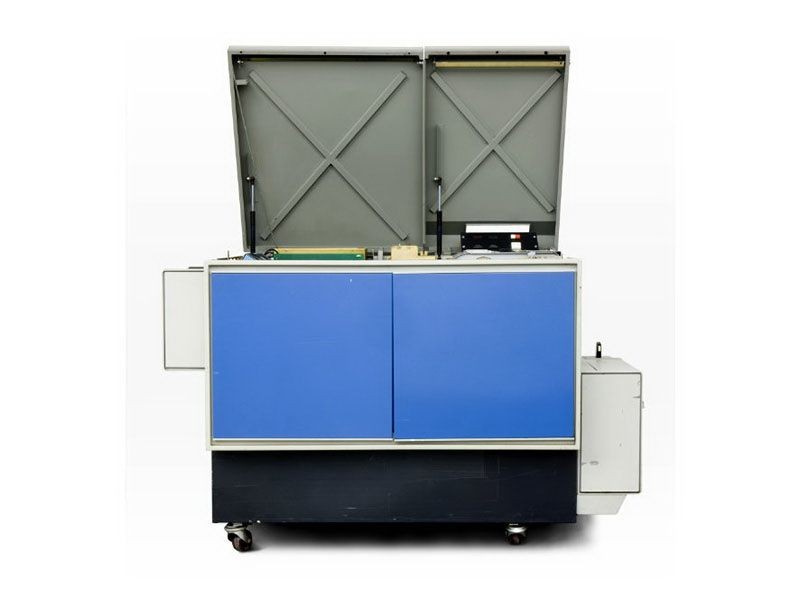
Dover laser printer
Xerox PARC physicist Gary Starkweather realizes in 1967 that exposing a copy machine’s light-sensitive drum to a paper original isn’t the only way to create an image. A computer could “write” it with a laser instead. Xerox wasn’t interested. So in 1971, Starkweather transferred to Xerox Palo Alto Research Center (PARC), away from corporate oversight. Within a year, he had built the world’s first laser printer, launching a new era in computer printing, generating billions of dollars in revenue for Xerox. The laser printer was used with PARC’s Alto computer, and was commercialized as the Xerox 9700.

Ray Tomlinson
In the early 1970s email makes the jump from timesharing systems – each with perhaps a couple of hundred users – to the newly burgeoning computer networks. Suddenly, messages are free to travel anywhere the network goes, and email explodes. Ray Tomlinson of Bolt, Beranek and Newman chooses the now-iconic “@” sign for his networked email protocol on the ARPAnet and by 1973, well over 50% of traffic on that research-oriented network is email. Nearly all other networks add email features. On the PLATO educational system, the email features of PLATO Notes are a runaway success both for person-to-person mails and as the basis for discussion boards.