

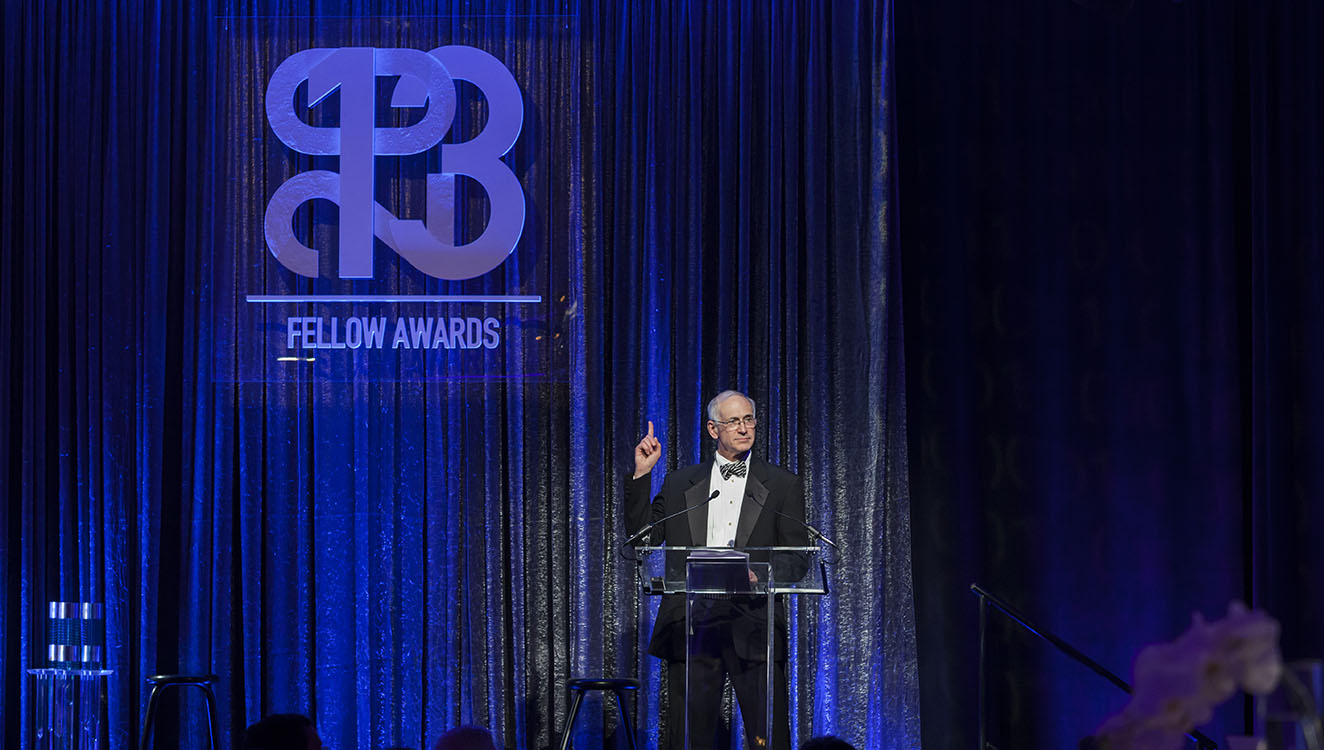
Charles Thacker
For leading development of the Xerox PARC Alto, and for innovations in networked personal computer systems and laser printing technologies.

"Complexity is the enemy -- Exterminate features."
Charles Thacker

Chuck Thacker was born February 26, 1943 in Pasadena, California.

Educated in physics at the University of California at Berkeley, Thacker joined the university's "Project Genie" in 1968, an effort that resulted in one of the most successful early timesharing systems.  The Genie team later formed the Berkeley Computer Corporation, and there Thacker led the design of their new computer's processor and memory subsystem. Although not a commercial success, BCC supplied the core group of technologists for the newly-formed Computer Science Laboratory (CSL) at the Xerox Palo Alto Research Center (PARC), which Thacker joined in 1970.

During his thirteen years at PARC, Thacker led the hardware development of many of the innovative systems developed at CSL. He was the project leader of the MAXC timesharing system, one of the first systems to make use of semiconductor memory, and of the Alto workstation, the first personal workstation using a bit-mapped display and mouse to provide a user interface based on overlapping windows.   Responsible for the design and engineering of the Alto hardware, Thacker also wrote much of its microcode, hand-built the first batch of Altos, and oversaw production for the rest.

At PARC Thacker was co-inventor (with Metcalfe, Boggs, and Lampson) of the Ethernet local area network.  He contributed to the world's first laser printer, and to the "Dorado" high-performance personal workstation.   He also designed and implemented the SIL CAD system, which was used by most of PARC's hardware designers throughout the 1970s.
 
In 1983 Chuck was a founder of DEC's Systems Research Center (SRC) in Palo Alto, California.  There he led hardware development of the "Firefly", the first multiprocessor workstation, and the Alpha Demonstration Unit, the first Alpha-architecture multiprocessor.  Thacker also worked in computer networking, leading development of AN1 and AN2 networking systems.

In 1997, he joined Microsoft to help establish the company's Cambridge, U.K. Research Laboratory. After returning to the U.S. in 1999, he joined the newly-formed Tablet PC group and managed the design of the first prototypes of this new device.  He is currently establishing a group at Microsoft Research in Silicon Valley to explore new areas in computer architecture.
 
Thacker is a member of the IEEE, a fellow of the ACM, a member of the American Academy of Arts and Sciences.  He is also a member of the National Academy of Engineering, which awarded him (with Butler Lampson, Alan Kay and Robert Taylor) the 2004 Charles Stark Draper prize "for the vision, conception, and development of the first practical networked personal computers."  In 2007, he was awarded the IEEE Von Neumann Medal "for a central role in the creation of the personal computer and the development of networked computer systems."
 
Thacker holds a B.S. degree in Physics from UC-Berkeley (1967) and an Honorary Doctorate from the Swiss Federal Institute of Technology (ETH-Zurich).

Copyright © 2008 Computer History Museum Privacy | Copyright | Feedback | Sitemap